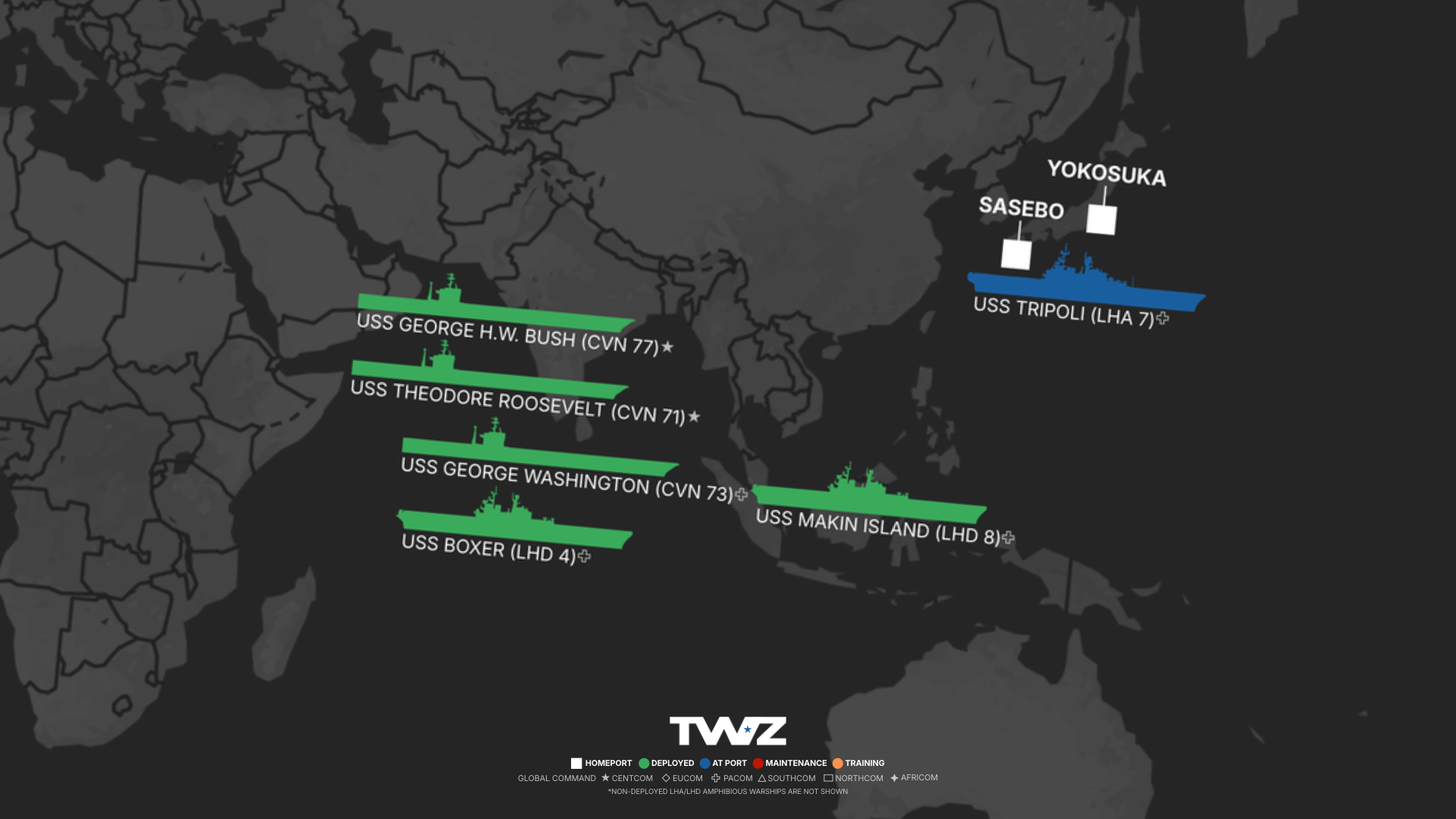
INTERNATIONAL DESK — The United States naval force posture in the Middle East has shifted following the arrival of the USS Theodore Roosevelt in the region, where it has relieved the USS George Washington. The transition, captured in recent maritime deployments, temporarily placed three American aircraft carriers in the area before the George Washington Carrier Strike Group departed for its expected return journey to Yokosuka, Japan.
The USS Theodore Roosevelt crossed into the U.S. Central Command area of responsibility on or around November 15 following a departure from Singapore on November 8 and a transit through the Strait of Malacca. The warship was accompanied by the guided-missile cruiser USS Chosin and the guided-missile destroyer USS Decatur, while the final element of the strike group, the destroyer USS Carl M. Levin, has operated separately in the theater since October.
During the brief period when three flattops overlapped in the region, the deployed Carrier Air Wings comprised ten squadrons of F/A-18E/F Super Hornets, two squadrons of F-35C Lightning IIs, and three squadrons of EA-18G Growlers. While both the George Washington and the Roosevelt embark stealthy F-35C squadrons, the USS George H.W. Bush remains certified to employ Super Hornets and Growlers, maintaining the ongoing one-for-one tactical jet swap.
Broader naval logistics reflect wider fleet management challenges, as the final elements of the long-deployed Abraham Lincoln Carrier Strike Group returned home and the amphibious assault ship USS Boxer relocated from the Middle East while its replacement, the USS Makin Island, positioned in Singapore. Meanwhile, the acting secretary of the Navy has advised senators that the naval service anticipates a five-year stretch operating nine aircraft carriers rather than the statutory requirement of 11.








Reader Discussion (0)
MODERATED · NO LINKS OR SPAMLoading reader comments...